Stockhausen, Es Ist Ihr Gehirn, Das Ich Suche
The Revolution Will Not Be Televised
Air Raid Siren
Artist's Statement
Like most of the assignments in this class, the webspinna project
required me to take advantage of modern media through the use of computer
technology and the internet. Technology in the digital age has opened the doors
to a myriad of creative possibilities, but it also implies some negative
consequences as well. Thematically, I decided to observe the age of modernity
and technology in both celebration and denunciation. The piece opens with anonymous
inorganic sounds, addressing the concept of using inventive tools to master
one’s domain by separating machinery from nature. Next, the trance-like
electronic wave sounds celebrate the new variety of sounds made possible in the
digital age and, by extension, the diversity of creative potential available
through the use of modern computer equipment. Conversely, the soliloquy about
urban unrest entitled “The Revolution Will Not Be Televised” by poet Gil
Scott-Heron illustrates the discord that is possible in the contemporary age,
especially in the sprawling metropolitan environment. The monologue is filled
with pop culture references about television and modern commercialism. Finally,
the mix ends with the unnerving, prophetic sound of an air raid alarm siren,
which exemplifies the atrocities that have become possible through advancements
in military technology. This contrast in themes illustrates the spectrum of
benefits and difficulties that accompany the powerful capacities of modern
scientific application in technology.
Sharing my webspinna proved to be a rewarding experience. I
worked very hard to select and orchestrate my sounds and spent a great deal of
time rehearsing them. The day after the performance, I received multiple
compliments on the piece from my peers in the class, which culminated in a
rather serious case of the warm-fuzzies. The evening of the performance was an
excellent opportunity to network and bond with my fellows, and was a uniquely entertaining
experience.
This webspinna is simply an arrangement of preexisting
recordings or generations of sound, which draws upon cultural preconceptions as
artistic shorthand in drawing associations. As this eclectic compilation is presented,
new thematic meaning and artistic value emerge. Paul D. Miller (aka “D.J.
Spooky”) deliberates on this phenomenon: “The artist, navigating the
innumerable ways to arrange the mix of cultural ideas and objects that bombard
us, uses technology and art to create something new and expressive and
endlessly variable. Technology provides the method and model; information on
the web, like the elements of a mix, doesn't stay in one place. And technology
is the medium, bridging the artist's consciousness and the outside world” (Rhythm Science). Even though the sounds
collected in my webspinna are not my own fabrications, their synergy became my
own unique creation at the moment of their assemblage.
Pablo Picasso’s mixed-medium
collage entitled "Compotier avec
fruits, violon et verre" (1912) is conceptually similar to the webspinna
assignment: both are collations of preexisting imagery compiled in a manner
that generates new meaning that is different and more than the sum of the
componential fragments. True to the nature of Picasso’s cubist style, the piece
offers a depiction of fruit and a guitar (both are auteur motifs in his art) in
a shattered mode of existence. In fact, the collage uses only enough explicit
imagery to suggest the presence of
those objects covertly, but they are present nonetheless. Also like the
webspinna, the components have been removed from their original contexts,
thrusting their precise identities into obscurity. However the identification
of the original intent for each fragment is unimportant. All that matters is
the aesthetic characteristics of the components themselves as they contribute
to the medley.
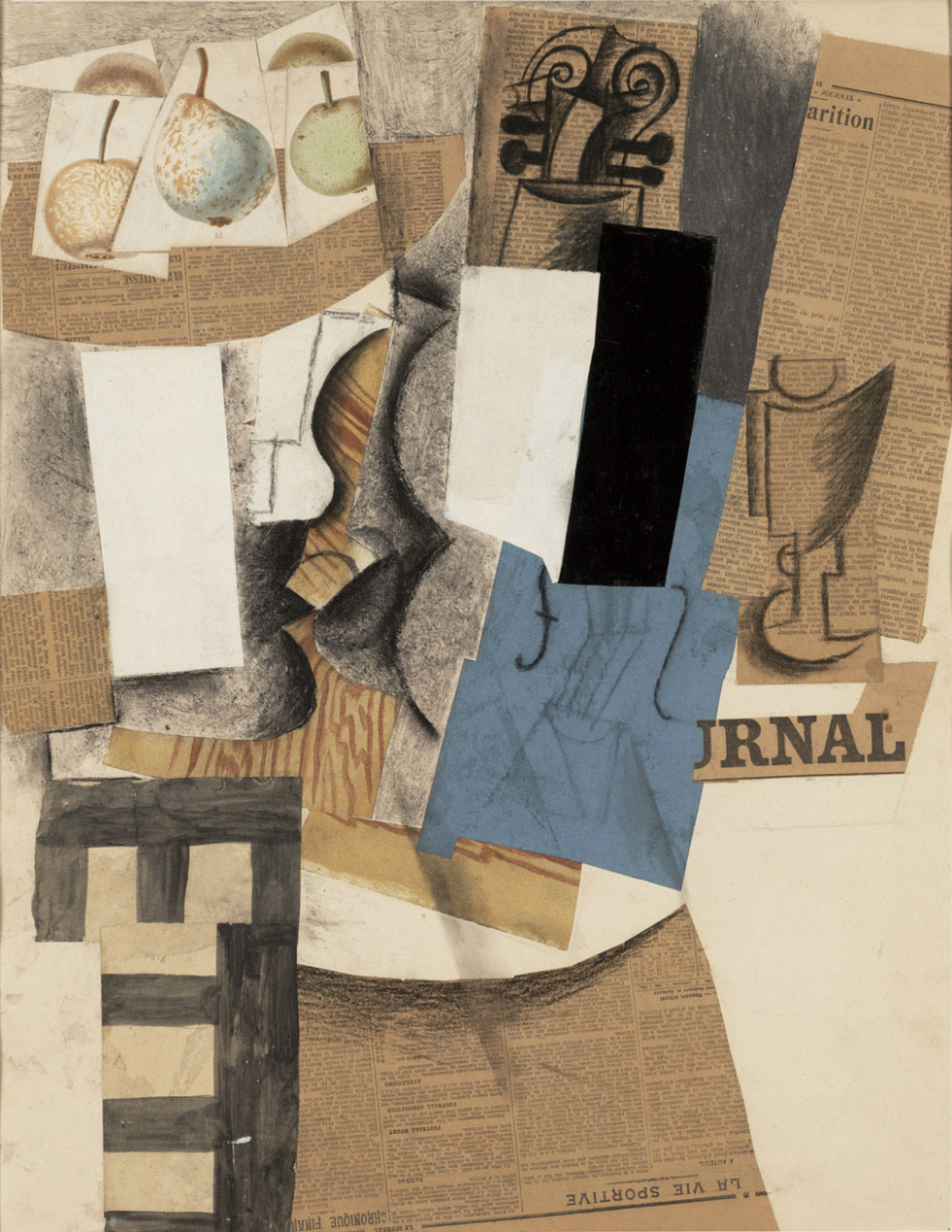
Pablo Picasso "Compotier avec fruits, violon et verre" (1912)

No comments:
Post a Comment